
Preparing for an exam is not just about reading textbooks, highlighting notes, or spending hours studying. The real question is: How much have you actually learned, and can you remember it when you need it?
Many students feel confident after reviewing their notes, but struggle when they face exam questions. This happens because reading information and remembering it independently are two different skills.
One of the best ways to prepare for an exam is to test your knowledge regularly. Self-testing helps you identify weak areas, improve memory, and understand whether you are genuinely ready for your exam.
In this guide, you'll discover 10 effective ways to test your knowledge before an exam, common mistakes to avoid, and how online quizzes can make your preparation more effective.
Why Should You Test Your Knowledge Before an Exam?
Testing yourself before an exam helps you move beyond simply recognizing information in your notes. It encourages you to recall answers without looking at the material.
This approach is often called active recall. Instead of reading the same information repeatedly, you try to retrieve what you have learned from memory.
Regular self-testing can help you:
Identify topics you haven't understood properly.
Discover gaps in your knowledge before exam day.
Improve your ability to remember important information.
Build confidence through regular practice.
Manage your study time more effectively.
Become familiar with different types of exam questions.
The goal isn't to get every question right. The goal is to discover what you need to improve while you still have time.
10 Effective Ways to Test Your Knowledge Before an Exam
1. Take a Practice Quiz
A practice quiz is one of the simplest ways to check how well you understand a subject.
Choose a topic you've already studied and answer questions without looking at your textbook or notes. Include different question types, such as multiple-choice questions, true-or-false questions, and short-answer questions.
After completing the quiz, review your answers carefully.
What to check:
Which questions did you answer correctly?
Which answers were incorrect?
Which questions did you guess?
Which topics need more revision?
Online platforms such as QuizPrepHub can help students practise with quizzes and assess their understanding.
2. Try Active Recall Instead of Rereading Notes
Reading your notes several times can make information feel familiar, but familiarity doesn't always mean understanding.
Active recall challenges your memory by asking you to remember information without looking at the answer.
For example:
Read a chapter about the human digestive system.
Close your textbook.
Write down the main organs and their functions.
Compare your answer with your notes.
Review anything you missed.
Repeat this process for difficult topics.
3. Solve Previous Exam Papers
Previous exam papers are useful because they show you how questions may be presented in an actual examination.
They can help you understand:
The structure of the examination.
Common question formats.
How marks are distributed.
How much detail is expected in answers.
Whether you can complete questions within the available time.
Try solving a previous paper under exam-like conditions. Avoid checking answers until you have finished.
Remember that previous papers are practice resources, not a guarantee of what will appear in your next exam.
4. Create Flashcards for Important Concepts
Flashcards are useful for testing definitions, formulas, vocabulary, dates, scientific terms, and important facts.
Write a question on one side and its answer on the other.
For example:
Front: What is photosynthesis?
Back: The process by which green plants use sunlight, water, and carbon dioxide to produce glucose and release oxygen.
Look at the question, recall the answer, and then check the reverse side.
Spend more time reviewing cards you find difficult rather than repeatedly practising information you already know.
5. Explain the Topic in Your Own Words
One of the best ways to check whether you understand a topic is to explain it as if you were teaching someone else.
Choose a concept and explain it using simple language without reading your textbook.
If you cannot explain an idea clearly, you may need to study it again.
For example, after studying fractions, try explaining:
What a fraction represents.
The difference between a numerator and denominator.
How to add two fractions.
Why common denominators are sometimes needed.
This technique helps reveal gaps in understanding that ordinary reading may not expose.
6. Take Timed Mock Tests
Knowing the correct answer is important, but answering within a limited time is also an essential exam skill.
Timed mock tests help you practise working under pressure.
To make your practice more realistic:
Set a timer based on the actual examination duration.
Choose questions from multiple topics.
Avoid using notes or external help.
Complete the test without unnecessary breaks.
Review your answers after finishing.
Record your score and completion time. As you practise, aim to improve both accuracy and time management.
7. Identify Your Weak Topics
Don't focus only on your overall score. Two students can achieve the same score but have very different learning needs.
For example, imagine a student completes a mathematics quiz and receives 70%.
Their topic-level performance looks like this:
Topic | Score | What to do |
|---|---|---|
Algebra | 90% | Maintain with revision |
Geometry | 80% | Practise occasionally |
Fractions | 60% | More practice needed |
Decimals | 40% | Revise and retest |
This analysis gives the student a clearer study direction.
Instead of repeating the entire syllabus, focus on the topics where improvement is most needed.
8. Mix Questions From Different Topics
Practising one topic repeatedly can sometimes make it easier to recognize the question pattern.
However, actual exams often contain questions from different chapters.
Try mixing questions from multiple topics in the same practice session.
For example, a mathematics practice quiz might include:
Fractions
Decimals
Algebra
Geometry
Percentages
This helps you practise identifying which method or concept is needed for each question.
9. Review Every Incorrect Answer
Getting a question wrong is not a waste of time. It is an opportunity to learn something you didn't understand.
When reviewing an incorrect answer, ask yourself:
Did I misunderstand the question?
Did I forget an important fact or formula?
Did I make a calculation mistake?
Did I confuse two similar concepts?
Did I guess instead of recalling the answer?
Read the explanation, revisit the relevant topic, and attempt a similar question.
Important: Don't simply memorize the correct answer. Understand why it is correct.
10. Retest Yourself After Revision
After identifying weak areas and reviewing them, take another quiz.
This is an important step because studying a topic again doesn't automatically mean you've mastered it.
Use this simple process:
Take an initial practice test.
Identify incorrect answers and weak topics.
Revise the relevant material.
Practise similar questions.
Take another test.
Compare your performance.
If your accuracy improves, you have evidence that your revision is helping.
How to Know If You're Ready for an Exam
There is no single score that guarantees exam readiness. However, several signs can help you assess your preparation.
You may be approaching exam readiness when you can:
Explain important concepts without looking at notes.
Answer questions from different chapters.
Solve practice questions accurately.
Complete mock tests within the time limit.
Explain why your answers are correct.
Recognize and correct your previous mistakes.
Maintain consistent performance across multiple practice sessions.
A high score on one easy quiz isn't enough. Try different question sets and check whether your performance remains consistent.
Common Mistakes Students Make When Testing Their Knowledge
Even when students practise regularly, some habits can make self-testing less effective.
Common mistake | Better approach |
|---|---|
Reading notes instead of testing memory | Use active recall |
Checking answers immediately | Finish the quiz first |
Practising only easy questions | Include different difficulty levels |
Ignoring incorrect answers | Review every mistake |
Focusing only on total scores | Analyse performance by topic |
Studying without a time limit | Practise timed mock tests |
Taking one quiz and stopping | Retest after revision |
Remember, effective exam preparation is about learning from your practice, not just completing more questions.
How Online Quizzes Can Improve Your Exam Preparation
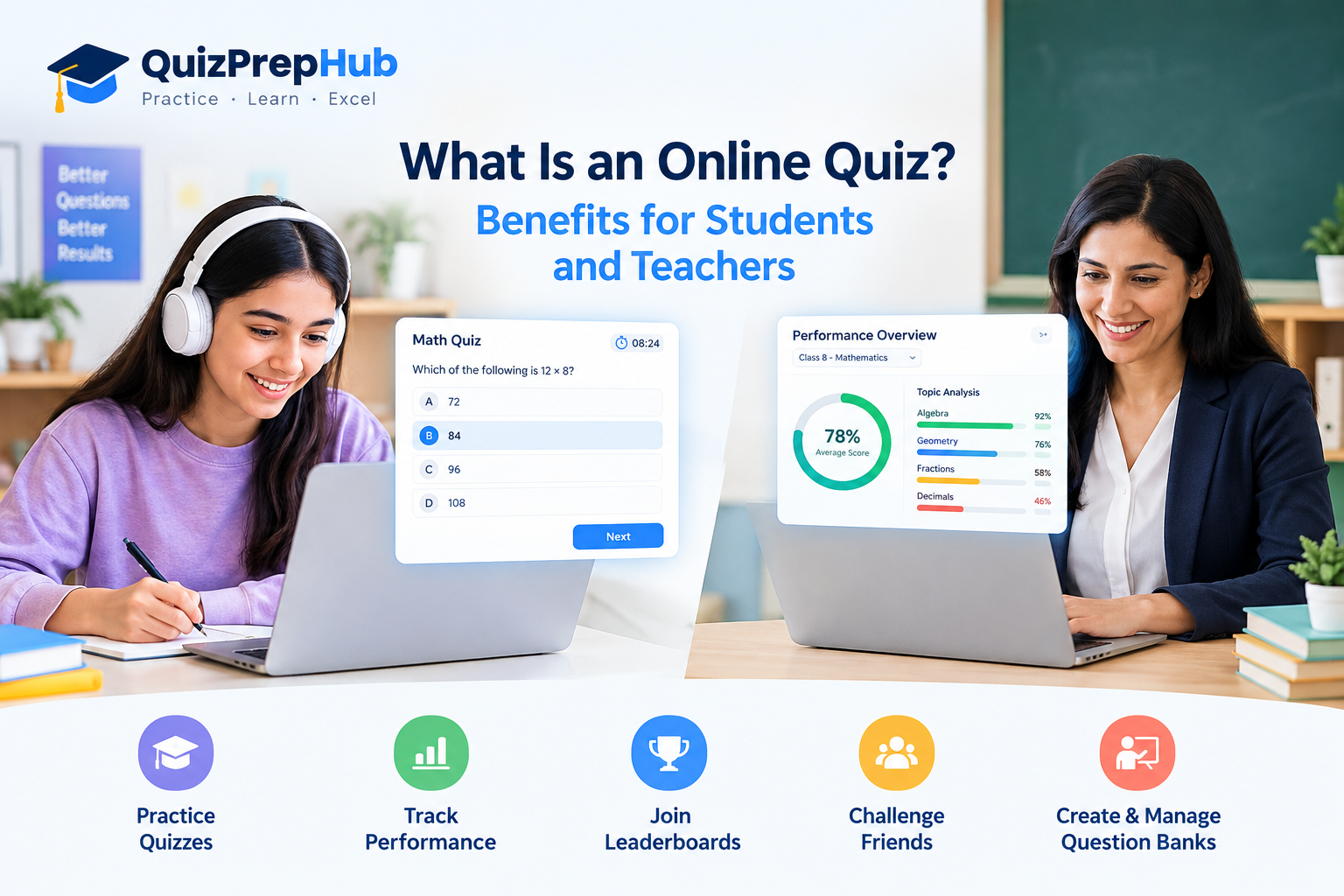
Online quizzes make it easier for students to practise regularly and check their understanding.
Depending on the platform, students can use online quizzes to:
Answer questions from different subjects.
Practise multiple-choice and other question formats.
Receive immediate feedback.
Identify incorrect answers.
Monitor their progress.
Challenge themselves through learning activities.
For teachers, online quizzes can also provide useful insights into student performance and help identify topics that need additional classroom attention.
With QuizPrepHub, students and teachers can explore an online learning environment focused on quiz practice, learning progress, and assessment.
A Simple 7-Day Knowledge Testing Plan Before an Exam
If your exam is approaching, use this seven-day plan to organize your practice.
Day | What to do | Goal |
|---|---|---|
Day 1 | Take a full practice quiz | Understand your current level |
Day 2 | Review weak topics | Improve understanding |
Day 3 | Practise active recall and flashcards | Strengthen memory |
Day 4 | Solve previous exam questions | Understand exam patterns |
Day 5 | Take a timed mock test | Improve time management |
Day 6 | Review mistakes and retest weak topics | Measure improvement |
Day 7 | Take a final practice test and revise key concepts | Check overall readiness |
Adjust the plan according to your syllabus, exam date, and available study time. Remember to include breaks and enough sleep.
Frequently Asked Questions (FAQs)
1. What is the best way to test your knowledge before an exam?
Taking practice quizzes, solving previous exam papers, using active recall, and completing timed mock tests are effective ways to check your understanding before an exam.
2. How many practice tests should I take before an exam?
There is no fixed number. Take enough practice tests to cover your syllabus, identify weak topics, and check whether your performance improves consistently.
3. Are online quizzes useful for exam preparation?
Yes. Online quizzes can help students practise questions, receive feedback, identify knowledge gaps, and monitor their progress. Their effectiveness depends on the quality of the questions and how students use the feedback.
4. Is it better to read notes or take practice tests?
Both are useful, but they serve different purposes. Reading helps you learn information, while practice tests help you check whether you can remember and apply it. Combining both methods is generally more effective than relying on reading alone.
5. What should I do if I keep getting quiz questions wrong?
Identify the topic behind each incorrect answer, review the relevant concept, understand the explanation, and attempt similar questions again. Don't move on until you understand your mistake.
6. How can I improve my exam confidence?
Prepare consistently, practise under timed conditions, review mistakes, and take multiple practice tests. Knowing which topics you understand and which need more work can help you feel better prepared.
7. Should I take a mock test one day before an exam?
You can take a short practice test to review your understanding, but avoid exhausting yourself with several full-length tests. Focus on reviewing important concepts, preparing your materials, and getting enough sleep.
8. Can practice quizzes improve memory?
Practice quizzes encourage active recall, which helps strengthen the ability to retrieve learned information. Reviewing mistakes and revisiting difficult topics can make this process more useful.
Final Thoughts
Preparing for an exam isn't just about how many hours you spend studying. It's also about knowing what you've learned and identifying what still needs improvement.
Practice quizzes, mock tests, flashcards, active recall, and previous exam papers can help you measure your understanding before exam day.
Don't wait until the final examination to discover your weak areas. Test yourself regularly, learn from your mistakes, and keep improving.
Study smart. Test your knowledge. Improve every day.
Explore QuizPrepHub to discover quiz-based learning and make knowledge testing part of your exam preparation routine.