

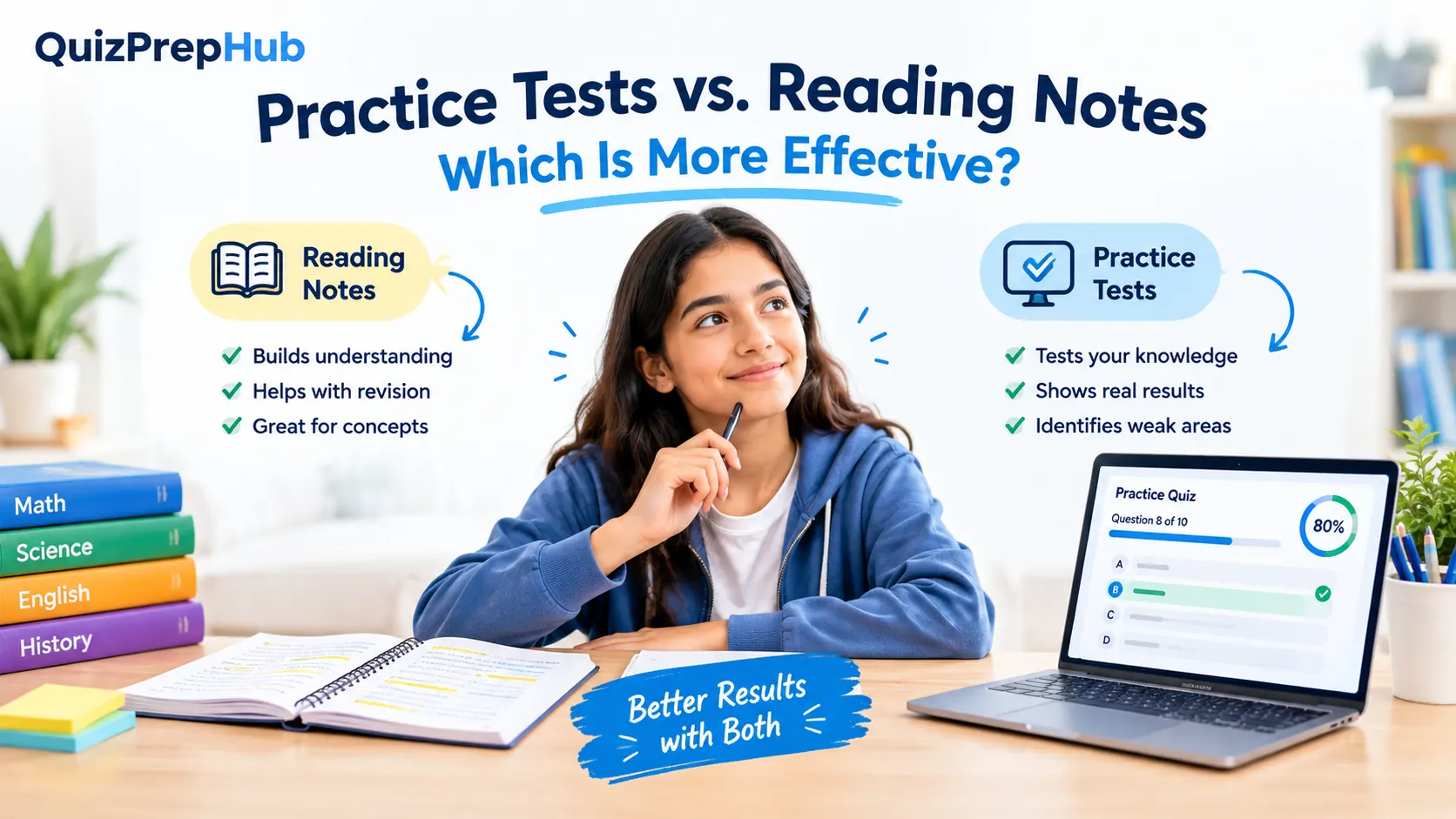
When preparing for an exam, students often face the same question: Should I spend more time reading my notes or solving practice tests?
Some students prefer reading textbooks, highlighting important points, and reviewing notes repeatedly. Others believe solving quizzes and mock exams is the best way to prepare.
Both methods have value, but they serve different purposes. Reading notes helps you understand information, while practice tests help you check whether you can remember and apply what you've learned.
So, which method is more effective?
The short answer: Practice tests are generally more effective for checking knowledge and strengthening long-term recall, while reading notes is essential for learning and understanding new concepts. Combining both methods is usually the smartest approach.
In this guide, we'll compare practice tests and reading notes, explain their benefits, and show you how to combine them into an effective exam preparation routine.
1. What Is the Difference Between Practice Tests and Reading Notes?
Before comparing the two methods, let's understand how each one works.
What Are Reading Notes?
Reading notes involves reviewing information from textbooks, classroom notes, summaries, or study guides to understand and remember important concepts.
Students commonly use this method to:
Learn new topics and concepts.
Understand definitions and explanations.
Review important formulas and facts.
Summarize lengthy chapters.
Prepare for upcoming lessons and examinations.
For example, a student studying the water cycle might read notes about evaporation, condensation, precipitation, and collection.
Reading helps the student become familiar with these concepts and understand how the process works.
What Are Practice Tests?
Practice tests are assessments that allow students to answer questions about topics they have already studied.
They can include:
Multiple-choice questions (MCQs).
True-or-false questions.
Short-answer questions.
Fill-in-the-blank questions.
Problem-solving questions.
Timed mock examinations.
For example, after studying the water cycle, a student might answer 10 questions about evaporation, condensation, and precipitation without looking at their notes.
This process helps students discover what they remember and which concepts need more revision.
2. Practice Tests vs. Reading Notes: A Quick Comparison
Both methods support learning, but their benefits are different.
Comparison | Reading Notes | Practice Tests |
|---|---|---|
Main purpose | Understand information | Test knowledge and recall |
Learning new topics | Very useful | Best after initial learning |
Memory practice | Depends on how you study | Actively requires recall |
Identifying weak areas | Can be difficult | Helps reveal knowledge gaps |
Exam preparation | Builds subject understanding | Builds exam readiness |
Time management | Usually self-paced | Can include timed questions |
Feedback | Requires self-review or guidance | Can provide scores and explanations |
Measuring progress | Less direct | Easier through repeated results |
The key difference: Reading notes helps you learn the material, while practice tests help you find out how well you have learned it.
3. Why Are Practice Tests Effective for Exam Preparation?
Practice tests do more than measure your knowledge. They also encourage your brain to retrieve information without looking at the answer.
This process is known as retrieval practice or the testing effect.
Educational research has found that retrieving information through testing can improve later retention compared with simply studying the same material again. The benefits depend on factors such as the type of material, timing, feedback, and how the practice is designed.
Here are some important benefits.
1. They Help You Identify Knowledge Gaps
You may feel confident after reading a chapter, but answering questions can reveal what you haven't fully understood.
For example, a Grade 7 mathematics student may understand algebra but struggle with fractions.
A practice test can help identify this difference.
Instead of revising every chapter equally, the student can spend more time on fractions.
2. They Strengthen Memory Through Active Recall
When you answer a question without looking at your notes, you actively retrieve information from memory.
This is different from reading an answer and recognizing it.
For example:
Reading: Looking at the definition of photosynthesis.
Testing: Explaining photosynthesis without looking at the definition.
Regular retrieval practice can help make information easier to recall later.
3. They Prepare You for Actual Exam Questions
Exams require students to understand questions, select appropriate answers, solve problems, and manage time.
Practice tests give students opportunities to develop these skills before the actual examination.
You can practise different question formats and become more familiar with how questions are presented.
4. They Help You Measure Improvement
Taking multiple practice tests allows you to compare your performance.
For example:
Practice Test | Score |
|---|---|
First attempt | 45% |
Second attempt | 60% |
Third attempt | 75% |
Fourth attempt | 85% |
This example shows improvement across four practice sessions.
However, make sure the tests cover comparable topics and difficulty levels before concluding that your overall understanding has improved.
5. They Build Exam Confidence
Uncertainty is one reason students feel nervous before examinations.
Practice tests can help reduce that uncertainty by showing what you understand and what needs more work.
When students regularly practise questions, review mistakes, and improve their results, they can develop greater confidence in their preparation.
4. Why Are Reading Notes Still Important?
If practice tests are so useful, should students stop reading notes?
Absolutely not.
Practice tests work best when students have already learned the concepts they are trying to recall.
Reading notes plays an important role in building that understanding.
1. They Help You Understand New Concepts
You cannot answer questions about a topic you have never studied.
Reading textbooks, classroom notes, and explanations introduces new information and helps you understand how different concepts connect.
2. They Provide Detailed Explanations
Some subjects require more than remembering facts.
For example, students studying science need to understand how and why certain processes happen.
Reading detailed explanations can help them understand concepts before attempting related questions.
3. They Are Useful for Learning Formulas and Definitions
Mathematics, physics, chemistry, biology, and other subjects contain important formulas, definitions, and rules.
Reading notes helps students review these materials and understand when to use them.
4. They Help Correct Misunderstandings
If you answer a practice question incorrectly, returning to your notes can help you understand the concept behind the correct answer.
This is why reading and testing should work together rather than compete with each other.
5. Which Study Method Is Better for Different Subjects?
The most effective approach may depend on the subject and the type of knowledge you need to develop.
Subject | Reading Notes | Practice Tests |
|---|---|---|
Mathematics | Understand formulas and methods | Solve problems and apply formulas |
Science | Learn concepts and processes | Test definitions and applications |
English | Understand grammar rules and vocabulary | Practise grammar, comprehension, and vocabulary |
History | Understand events and timelines | Recall dates, events, and causes |
Computer Science | Learn programming concepts | Solve coding and logic questions |
Geography | Study maps and geographical concepts | Test locations, facts, and applications |
For mathematics, for example, reading a worked solution can help you understand a method. Solving similar questions independently helps you check whether you can apply it.
For history, reading helps you understand events and their causes, while practice questions help you recall important details and explain relationships.
6. The Best Study Strategy: Combine Reading Notes and Practice Tests
Rather than choosing only one method, create a study routine that uses both.
Here is a simple five-step approach.
Step 1: Read and Understand the Topic
Start by reading your textbook, classroom notes, or study material.
Focus on understanding the main concepts instead of memorizing every sentence.
Step 2: Close Your Notes and Recall Information
After studying, close your book and try to remember the important points.
Write down key facts, explain the topic in your own words, or create questions from what you have learned.
Step 3: Take a Practice Quiz
Answer questions without looking at your notes.
Start with basic questions and gradually include more challenging ones.
Step 4: Review Incorrect Answers
Check your answers and identify where you made mistakes.
Ask yourself:
Did I forget the information?
Did I misunderstand the concept?
Did I make a calculation error?
Did I misunderstand the question?
Return to your notes when you need clarification.
Step 5: Take Another Test
After revising your weak areas, attempt another quiz.
Compare your results and check whether you can now answer the questions correctly.
This process turns mistakes into learning opportunities.
7. A Simple 60-Minute Study Plan
You don't need to spend several hours studying one topic. A structured one-hour session can help you balance understanding and practice.
Here is an example:
Activity | Time | Purpose |
|---|---|---|
Read study notes | 20 minutes | Understand the topic |
Recall key concepts | 10 minutes | Check memory |
Take a practice quiz | 15 minutes | Test understanding |
Review incorrect answers | 10 minutes | Learn from mistakes |
Quick revision | 5 minutes | Reinforce important points |
Total | 60 minutes |
Adjust the timing according to your subject, grade, and difficulty level.
For a challenging topic, you may need more time to understand the material before testing yourself.
8. How Students Can Use Online Quizzes to Practise More Effectively
Online quizzes make it easier to test your understanding without creating a new paper test every time.
Students can use them to:
Practise questions by grade and subject.
Test individual chapters and topics.
Review answers and explanations.
Identify areas that need more practice.
Compare results across practice sessions.
Set personal learning goals.
For example, a Grade 8 student preparing for a mathematics examination can practise algebra, fractions, geometry, and percentages separately.
After identifying a difficult topic, the student can return to their notes, revise the concept, and attempt another quiz.
You can explore the QuizPrepHub Quiz Library to browse practice quizzes by grade and subject.
Students can also visit the QuizPrepHub student page to learn about grade-wise practice, progress tracking, XP, and learning challenges.
9. How Teachers Can Combine Practice Tests and Classroom Notes
This approach is also useful for teachers.
Reading materials help teachers explain concepts, while quizzes provide feedback about whether students have understood the lesson.
Teachers can follow a simple classroom process:
Explain the topic using lessons, examples, and study notes.
Share a short quiz after completing the lesson.
Review individual answers and overall class performance.
Identify questions or concepts that students found difficult.
Revisit those concepts and provide additional exercises.
Use a follow-up quiz to check understanding.
For example, if students perform well in algebra but struggle with fractions, the teacher can focus the next revision session on fractions.
QuizPrepHub provides teachers with tools to create and share quizzes, review student answers, and examine class performance.
Explore the QuizPrepHub teacher and school page to learn more about its classroom assessment and analytics features.
10. Common Study Mistakes to Avoid
Even students who study regularly can make mistakes that reduce the effectiveness of their preparation.
Mistake | What to do instead |
|---|---|
Reading the same notes repeatedly without testing yourself | Add regular practice questions |
Taking tests without studying the topic first | Understand the basics before testing |
Memorizing answers without understanding concepts | Focus on why an answer is correct |
Ignoring incorrect answers | Review mistakes and revisit difficult topics |
Practising only easy questions | Include different difficulty levels |
Studying everything at the last minute | Spread revision across multiple sessions |
Focusing only on test scores | Analyse topic-level performance |
Taking quizzes without reviewing results | Use feedback to plan your next study session |
Remember that the purpose of studying is not simply to finish chapters or collect high quiz scores. It is to develop understanding and the ability to use what you have learned.
Frequently Asked Questions (FAQs)
1. Are practice tests better than reading notes?
Practice tests are generally more effective for checking knowledge and strengthening recall, especially over time. Reading notes is important for learning new concepts and understanding difficult topics. Combining both methods is usually the best approach.
2. Should I read notes before taking a practice test?
Yes. If you are studying a new topic, begin by reading and understanding the material. Then take a practice test to check what you remember. You can also use short quizzes to assess your existing knowledge before revision.
3. Do practice tests improve memory?
Practice tests encourage retrieval practice, which can improve the ability to remember information later. Reviewing feedback and revisiting incorrect answers can make practice more useful.
4. How many practice tests should I take before an exam?
There is no fixed number. Take enough tests to cover the syllabus, identify weak topics, and check your progress. Focus on understanding and learning from mistakes rather than completing as many tests as possible.
5. Is reading notes enough to prepare for an exam?
Reading notes can help you understand and revise information, but it may not show whether you can recall and apply that information independently. Include practice questions and mock tests in your preparation.
6. What is active recall in studying?
Active recall is a study technique in which you try to remember information without looking at your notes or textbook. Answering practice questions, using flashcards, and explaining concepts from memory are examples.
7. When should I stop reading and start practising questions?
Once you understand the basic concepts of a topic, start practising questions. You do not need to finish reading the entire syllabus before testing yourself. Short quizzes can also help you identify which parts need more explanation.
8. Are online quizzes useful for exam preparation?
Yes. Online quizzes can help students practise different question types, check their understanding, review mistakes, and monitor improvement. The most useful results come when students use quiz feedback to guide further revision.
9. What should I do after getting a low score on a practice test?
Don't panic. Review incorrect answers, identify the topics behind your mistakes, revisit your notes, and practise similar questions. Take another test after revision to check whether your understanding has improved.
10. What is the best study routine before an exam?
A balanced routine includes reading and understanding topics, practising active recall, solving questions, reviewing mistakes, and taking timed mock tests. Spread your preparation across multiple sessions instead of relying entirely on last-minute revision.
Final Thoughts: Don't Just Read. Test What You Know.
Reading notes and taking practice tests are not competing study methods. They are two important parts of effective exam preparation.
Reading helps you understand what you need to learn. Practice tests help you discover what you can remember and apply independently.
The best approach is simple:
Read → Understand → Practise → Review → Improve.
Don't wait until exam day to discover what you haven't learned. Test your knowledge regularly, learn from your mistakes, and focus on the topics that need more attention.
Explore QuizPrepHub to make quiz-based practice part of your learning routine.
Study smarter. Practise regularly. Be ready for your next exam.